Dinamica EGO 8
Overview
EGO stands for Environment for Geoprocessing Objects. Dinamica EGO is a spatial modeling platform for environmental modeling, flexible enough to design anything from a simple static spatial model to a complex dynamic simulation.
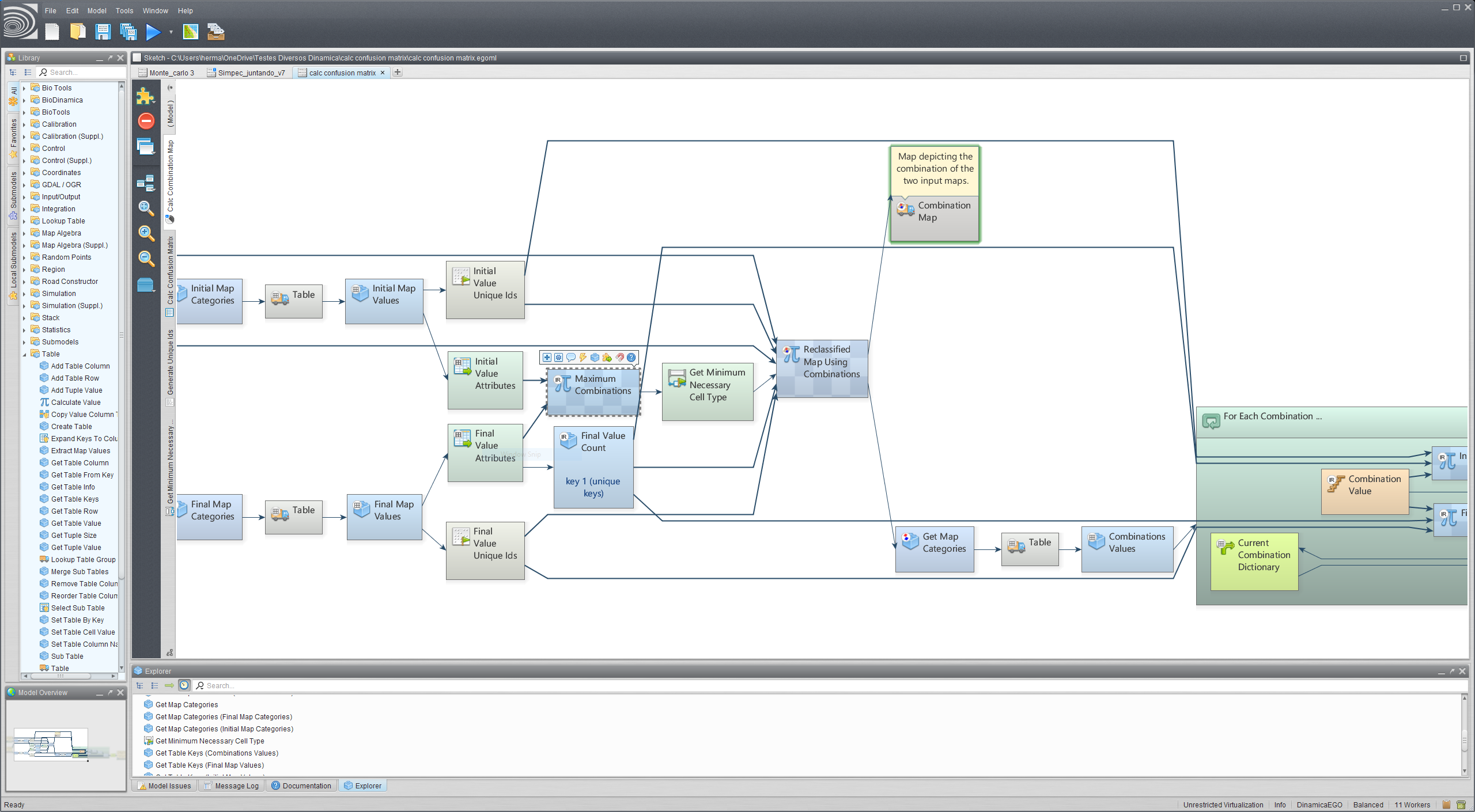
The software is written in C++ and Java. Its algorithms, called functors, are sequenced in graph form to build a visual data flow: each functor performs one operation, and functors connect to each other through their ports, where each port represents a connector to a data element such as a map, a table, a matrix, an expression, or a constant. Models are built by dragging functors from the Functor Library panel onto the canvas and connecting their ports, so the model itself is a diagram whose execution follows the resulting data flow chain. Models can be saved as EGO Script, EGOML Script, or EGOMLX. See the Dinamica Reference for the full language, type, and functor reference.
Dinamica EGO implements the most common spatial analysis algorithms found in commercial GIS software, plus a series of algorithms designed specifically for spatial simulation, including transition functions and calibration and validation methods.
Key Features
Modeling and design
- Decision processes for bifurcating and joining execution pipelines
Simulation
- Nested iterations
Functors and calibration
Performance
Extensions
Dinamica EGO favors simplicity, flexibility, and performance, optimizing speed and computer resources such as memory and parallel processing.
Documentation
Getting Started
Language and Type Reference
Interfaces
Reference
Guides and Tips
Language Integration
Plugins, Utilities, and Community
Model Examples and Datasets
Note: Example models and datasets are available at guidebook_dinamica_5.rar.